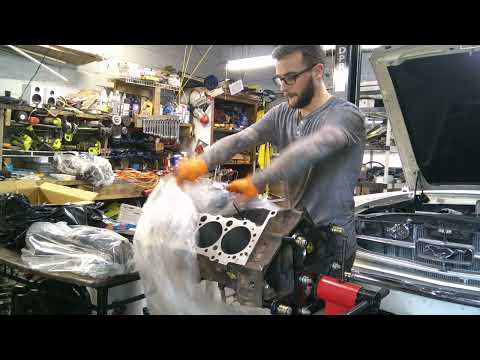
Small Block Chevy 350 Build Pt.5 | Continued frustrations with rod clearances
This episode continues a Small Block Chevy 350 engine build focusing on persistent rod-to-block and rod-to-crank clearance issues. The work covers mock assembly, measuring journals and clearances (including with Plastigage), making corrective machining adjustments or part changes, and re-checking until acceptable clearances are achieved.
Build Sequence
1. Mock assemble rods and crank
Mount the short block on an engine stand and install connecting rods (with caps) onto the crank without final torque. Rotate by hand to check for binding, interference, and obvious clearance problems between rods and block/crank.
2. Measure journals and rod bores
Use a micrometer and dial bore gauge to measure crank journals and rod big-end bores to establish actual diameters for clearance calculations. Record measurements for each rod/journal pair.
3. Check bearing oil clearance with Plastigage
Install new or test bearings, lay Plastigage strips on journals, assemble rod caps finger-tight, then rotate and disassemble to read flattened Plastigage width and compare to spec to determine oil clearance.
4. Diagnose clearance issues and options
Interpret measurements: too-tight clearances may require rod regrinding, undersize bearings, crank journal polishing, or replacing incorrect-size rods/bolts. Decide whether in-shop machining or parts replacement is needed.
5. Send rods/crank to machine shop or perform controlled clearance corrections
If required, have rods resized, align-bored, or fillet-ground by a machine shop; alternately perform minimal, controlled material removal on rod edges to correct interference. Re-measure after work.
6. Recheck clearances after corrective work
Repeat mock assembly and Plastigage checks to verify that rod-to-crank oil clearance and rod-to-block clearances now fall within acceptable specifications. Inspect bearing surface condition closely.
7. Final assembly with new bearings and proper torque
Install final bearings, apply assembly lube, torque rod bolts to spec (or torque-to-yield procedure if applicable), and perform a final rotation check to ensure smooth movement and correct endplay.
Frequently Asked Questions
How do I know if my rod clearances are too tight or too loose?
Measure crank journal and rod bore diameters with a micrometer/dial bore gauge and use Plastigage during mock assembly to read bearing oil clearance; compare readings to Small Block Chevy 350 spec charts. Tight clearances cause binding or heavy drag on rotation; loose clearances show excessive flattened Plastigage and may cause low oil pressure or knocking.
VIEW FULL ARTICLE →Can I file or grind my rods myself to correct interference?
Minor cleanup of rod edges may be acceptable for slight interference, but any work that changes bearing bores or critical dimensions should be done by a machine shop. Improper grinding can ruin the rod or create dangerous stresses.
VIEW FULL ARTICLE →Is Plastigage accurate enough for final clearance checks?
Plastigage is accurate enough for quick verification and troubleshooting, but for final precision work use micrometers, bore gauges, and calculation of diameter differences; machine-shop measurements are the most reliable for final acceptance.
VIEW FULL ARTICLE →What causes repeated rod clearance problems on a SBC 350?
Causes include mismatched rod and crank journal sizes, incorrect bearing selection, out-of-spec rods or crank journals, bent or worn rods, or incorrect machining tolerances from previous work. Systematic measurement and matching of parts resolves most issues.
VIEW FULL ARTICLE →When should I replace rod bolts?
Replace rod bolts whenever the manufacturer or ARP recommends single-use bolts (torque-to-yield), if bolts show stretch or damage, or if you're reassembling after machining. Upgrading to quality bolts is common during rebuilds to ensure consistent clamping.
VIEW FULL ARTICLE →Related Builds
 Small Block Chevy 350 Build Pt. 6 | This Is How It's Actually Supposed To Be Done
 Small Block Chevy 350 Build Pt.3 | Filing rings and checking main clearances
 Small Block Chevy 350 Build Pt. 11 | Installing the intake manifold and figuring out sbc nuisances
 Small Block Chevy 350 Build Pt. 7 | Checking Crank Clearance and installing the rods.
 Small Block Chevy 350 Build Pt. 8 | Installing Camshaft and timing components
 Small Block Chevy 350 Build Pt.1 | Lifting This Engine Without Breaking It
Parts Used (7)
Standard oversize or standard bearings used to achieve correct oil clearance depending on measurements.
Replaced or checked during reassembly to ensure main clearances are within spec when adjusting rods.
Used to check rod-to-crank oil clearance quickly on each journal.
Recommended to replace rod bolts when checking and reassembling; important for proper torque/stretch.
Checked/replaced if axial play or endplay issues are found while mock assembling rotating assembly.
Service cost to correct rod journal clearance or to line-bore/resize rods to fit crank journals.