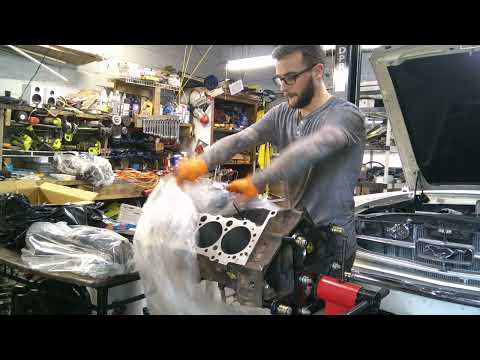
Small Block Chevy 350 Build Pt.4 | Rod Bearing Clearance Check Goes Wrong
This episode checks rod bearing clearances on a Small Block Chevy 350 using Plastigage and common measuring tools. The clearance check reveals a problem (clearance too tight/out of spec) that requires diagnosis and corrective action such as swapping bearing sizes or machining the crank.
Build Sequence
1. Prepare engine and access rods
Secure the engine on a stand, remove oil pan and rod bearing caps as needed to access rod bearings and crank journals. Clean journals and bearing surfaces of oil and debris.
2. Inspect journals and bearings
Visually inspect rod bearings, rod bores and crank journals for scoring, discoloration or damage. Use a micrometer to measure crank journal diameters to establish wear or undersize condition.
3. Install bearings and apply assembly lube
Install the rod insert into the rod and cap, apply a thin bead of assembly lube to the bearing surface where the crank will contact it. Ensure bearings are seated properly.
4. Measure clearance with Plastigage
Place a strip of Plastigage on the journal, reinstall and torque the rod cap to specified torque, then remove the cap and compare the flattened Plastigage width to the provided scale to determine oil clearance.
5. Rotate and verify
Manually rotate the crank to ensure free movement and to verify binding or tight spots. If the crank does not rotate freely or binds, note which journal/rod is affected for diagnosis.
6. Diagnose incorrect clearance
If measured clearance is out of spec (too tight or too loose), measure journal and rod bore diameters to determine whether the issue is incorrect bearing size, worn journal, or rod deformation. Check bearing crush and cap seating.
7. Corrective actions
Correct the problem by installing the correct bearing size (selecting undersize if journals ground), replacing damaged bearings, or sending the crank for grinding/polishing. Reassemble and recheck clearances after corrective work.
8. Final reassembly and verification
After resolving clearance issues, re-torque rod caps to specification, perform a final crank rotation check, reinstall oil pan and any removed components, and perform a thorough inspection before engine start.
Frequently Asked Questions
How accurate is Plastigage for measuring bearing clearance?
Plastigage is accurate enough for quick checks and verification during assembly; it gives a reliable ballpark measurement. For precision work or final verification, use micrometers and bore/dial gauges to calculate clearance from measured diameters.
VIEW FULL ARTICLE →What causes a rod bearing clearance to be too tight?
Common causes include incorrect bearing thickness or size installed, excessive bearing crush from misaligned caps, undersized rod bores, or journals that are oversized due to prior machining/incorrect grinding.
VIEW FULL ARTICLE →If clearance is out of spec, what are my options?
Options include installing the correct sized bearings (standard/undersize), replacing damaged bearings, machining or grinding the crank to an undersize and using undersize bearings, or replacing bent/warped rods or the crank if severely damaged.
VIEW FULL ARTICLE →Can I reuse the Plastigage after one measurement?
No. Plastigage is a single-use product and must be replaced for each measurement. Also re-measure every rod journal after any corrective work to confirm final clearances.
VIEW FULL ARTICLE →What is the acceptable rod bearing clearance for a Small Block Chevy 350?
Typical rod bearing oil clearance for a SBC 350 is generally in the range of about 0.0015" to 0.003"; exact target depends on bearing spec and application. Always consult the bearing manufacturer or engine build spec for the precise target.
VIEW FULL ARTICLE →Related Builds
 Small Block Chevy 350 Build Pt. 6 | This Is How It's Actually Supposed To Be Done
 Small Block Chevy 350 Build Pt.3 | Filing rings and checking main clearances
 Small Block Chevy 350 Build Pt.5 | Continued frustrations with rod clearances
 Small Block Chevy 350 Build Pt. 11 | Installing the intake manifold and figuring out sbc nuisances
 Small Block Chevy 350 Build Pt. 7 | Checking Crank Clearance and installing the rods.
 Small Block Chevy 350 Build Pt. 8 | Installing Camshaft and timing components
Parts Used (3)
Standard 8- or 16-piece rod bearing set; video inspects and replaces bearings when clearance is incorrect.
Included as a potential part/cost if journals are damaged or require undersize grinding; actual need depends on inspection.