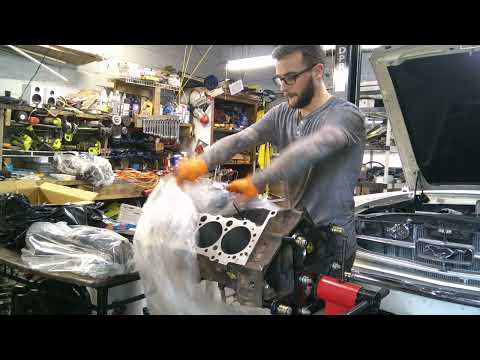
Small Block Chevy 350 Build Pt. 9 | Installing lifters and heads
This video covers installing lifters and cylinder heads on a Small Block Chevy 350 as part of a multi-part engine build. The work includes prepping the block and lifter bores, installing lifters and pushrods, placing head gaskets and heads, and torquing the head fasteners to spec before final assembly (valve covers, etc.).
Build Sequence
1. Inspect and clean block and lifter bores
Thoroughly clean the block deck, lifter bores and oil passages. Use solvent and rags to remove debris and ensure lifter bores are free of old lube or machining chips. Inspect bores for wear or damage.
2. Prepare lifters and prime if necessary
Inspect each lifter, apply assembly lube to the lifter faces and bores, and prime hydraulic lifters according to manufacturer recommendations (if required) before installation.
3. Install lifters
Carefully insert lifters into the correct bores in the correct order. Rotate or work each lifter to ensure it seats properly in the bore and has free movement.
4. Install pushrods
Install pushrods through the lifter valley making sure they seat in the lifter and align with the rocker arms. Verify pushrod length and fit; replace any bent or incorrect pushrods.
5. Prepare heads and gaskets
Clean head gasket surfaces on both heads and block, install dowels if required, and place new head gaskets aligned to cylinders and water/oil passages.
6. Set heads in place and install fasteners
Lower each cylinder head onto the gaskets and dowels, then hand-thread head bolts or studs. Follow the manufacturer's torque sequence and incremental torque steps when tightening the head fasteners.
7. Torque head bolts to specification
Perform torque passes in the correct order (usually multiple stages) using a calibrated torque wrench. If using torque-to-yield bolts, use new fasteners and follow the specified angle/torque procedure.
8. Check and adjust valvetrain
If using adjustable rockers or mechanical lifters, set valve lash. For hydraulic lifters, preload as specified and check for proper movement. Rotate the engine by hand to ensure no interference.
9. Final assembly (valve covers, lines, accessories)
Install valve cover gaskets and valve covers, reconnect any removed fittings, plug vacuum/coolant lines, and prepare for engine installation or startup.
Frequently Asked Questions
Do I need to replace my head bolts or can I reuse them?
If the engine uses torque-to-yield (TTY) head bolts you must replace them every time you remove the heads. For reusable head studs or non-TTY bolts, you can often reuse if they are in good condition, but replacing with quality studs/bolts is recommended during a rebuild.
VIEW FULL ARTICLE →How do I prime hydraulic lifters before installation?
Priming procedures vary by lifter manufacturer; common methods include soaking lifters in engine oil, using a priming tool, or repeatedly actuating them in oil to remove air. Follow the lifter maker's instructions to ensure proper function on initial startup.
VIEW FULL ARTICLE →What torque sequence and values should I use for SBC 350 heads?
Follow the head manufacturer or engine manual for the correct torque sequence and values. Typical multi-stage torqueing is used (e.g., incremental steps then final angle for TTY bolts), but exact numbers depend on bolt/stud type and gasket material.
VIEW FULL ARTICLE →How can I tell if a lifter is the correct type for my cam?
Check the cam profile and the cam manufacturer's recommendation—some cams require roller lifters while others use flat tappet lifters. Verify lifter internal design (hydraulic vs mechanical) and dimensions to ensure compatibility.
VIEW FULL ARTICLE →What signs indicate a problem after installing heads and lifters?
Noisy valvetrain (ticking or clacking), low oil pressure, or inability to rotate the engine by hand can indicate improper assembly, incorrect lifter seating, wrong pushrod lengths, or torquing errors. Stop and diagnose before running the engine.
VIEW FULL ARTICLE →Related Builds
 Small Block Chevy 350 Build Pt. 10 | Checking out a new intake and talking about things left to do
 This 65 Mustang Keeps Throwing Curveballs
 Small Block Chevy 350 Build Pt. 6 | This Is How It's Actually Supposed To Be Done
 Small Block Chevy 350 Build Pt.3 | Filing rings and checking main clearances
 Cub Cadet Ultima Z2 54 5 hour +some maintenance video
 Small Block Chevy 350 Build Pt.5 | Continued frustrations with rod clearances
Parts Used (7)
MLS or composite head gaskets sized for 350 deck thickness and heads chosen.
Full set to fit SBC 350; may be flat tappet or roller depending on cam. Confirm cam/lifter compatibility.
Remanufactured or aftermarket heads for SBC 350. Price varies widely by brand and material.
Torque-to-yield head bolts or ARP head studs recommended; replace bolts if using torque-to-yield.